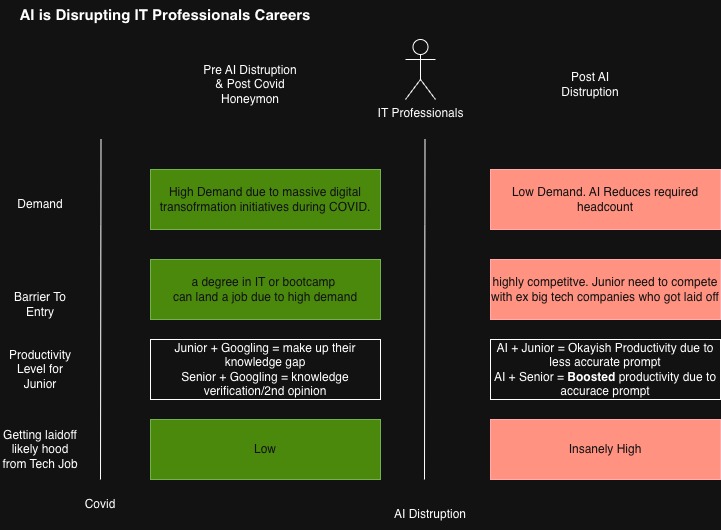
The End of an ERA
 IT Professionals are at risk to get laid off in current job market and economy situation.
Nothing last forever in this world.
- Phonebox replaced by mobile phone
- Some manual labor replaced by industry automation
- Horse replaced by motorized vehicle (car/truck/motorcycle)
- Post card replaced by email
- and so on..
Those phenomenon are the side effects of technology advancement which create a disruption to the existing technology adoption. Unfortunately, those technology advancement can’t be avoided as it can put any organization out of the market competition the momment they ditch AI because there are alot of benefits given by AI especially on the head reduction context which directly lower down the OPEX (operational expenditure).
The first AI chatbot (chatGPT) based on LLM (large language model) was released on Q4 2022 by openAI and followed by rapid adoption from the markets. Since then, AI started to change the way industry see information technology role for their business.
How Indstry See IT Now vs Then
LLM Based ChatBot reinvent almost every line of business process on the industry especially for human dependent operations as LLM can think like a human. Furthermore, an agentic AI can make decision as well as executing a task.
Programming is one of the operational task which deeply disrupted by agenticAI because its a language which has well documented syntax structure.
Almost every role during software engineering can be accelerated by the help of AI such as programmer, database engineer, business analyst, etc. Resulting in drastic headcount reduction and overall organization enterprise IT strategy.
Below are the differences of enterprise IT strategy between pre LLM era vs Post LLM era
| Parameter | Before AI Era | During AI Era |
|---|---|---|
| IT Department Headcount | Big team of development function | Less headcount. All software engineer are equipped with latest agentic AI tools for their area (coding/database/networking/infrastructure/etc) |
| OPEX | High opex due to the high number of headcount for IT Staff and outsourcing | Low opex due to head count reduction. |
| Data is the new oil | Lack of Digitalization Awareness | Massive digital transformation project to prepare to build foundation for AI system. |
| Hiring stratrgy for IT dept | More seasoned developer compared to the junior one (reverse pyramid) | Less senior developer but with more junior developer and equip them with AI agent (pyramid) |
| IT Dept skillset | Technical knowledge (coding/networking/infrastructure) | Technical knowledge + business domain + leadership |
Software engineering is not obsolete, its just evolving into new era of techno functional role as technical knwoledge become loose with the help of agenticAI specialized for coding/infrastructure/networking.
The aftermath of AI Revolution for Software Engineer
Job market for IT professionals including (but not limited to) software developer, devops engineer, solution architect network engineer, UI/UX designer, tester, business analyst are crashed almost in everyside of the world with different magnitude. 1st world country such as america are taking the highest toll where as 3rd world country like indonesia or philippines are least impacted due to the cheap labor cost.
For references, based on cloude data, typicallly a developer spend $200 credits per month and average software developer salary (entry level or mid level) are ranging from $400 to $1500. The ratio between average cloude code credit spend and the developer salary are relatively balanced. In other hand, entry level or mid level american software engineer could cost arround $8K to $12K per month! its equal to 50 cloude code account!
These situation are triggering US based company to hire developer from 3rd world country and equip them with AI. It causes the job market to be crashed. Demand for local IT professionals are decreasing due to outsourcing and reduced head count requirement. All because of AI.
Below are the recent layoff historical data in last 6 month (source: layoffs.fyi)
| Organization Location | Organization Name | Date | Number of Lay Off |
|---|---|---|---|
| US | Meta | April 2026 | 8000 |
| US | Oracle | March 2026 | 30000 |
| US | Dell | Mach 2026 | 11000 |
| India | Acko | April 2026 | 20 |
| Indonesia | Tokopedia | june~Agusut 2025 | 450 |
| Australia | Atlassian | March 2026 | 1600 |
| Sweden | Ericsson | January 2026 | 1600 |
— hence, IT professionals from both 1st world and 3rd world country are impacted, its just on different magnitude.
Mitigation Strategies to Survive on the new ERA of AI as Software Engineer
In context job IT job market crash, risk mitigation strategy is needed to reduce the laid off impact. The Major impact of getting laid off would be the inability to pay the bills especially for those who are providing for their family.
IT professionals are one of the most job prone to laid off at 2026. Ironic, thats the only word to describe current situation for IT fokls. They created a revolutionary “tools” called as AI(Artificial intellifence) to human beings doing day to day task but in same time, it also cause reduce the human intervention to perform the task especially on software engineering industry.
Nevertheless, in every revolution, eventhough some of jobs are getting sunset, a new opportunity is always manifested. As IT professionals we should look up into that mindset.
Below is end to end risk mitigation strategies for IT professionals in the age of AI
Risk Identification
First step to create risk mitigation strategies for surviving AI era as IT professionals is by identifying the lurking risk around us such as
- Financial Risk: Failed to pay monthly biils (food, mortgage, utility, health)
- Career Shift Risk: Forced to took non IT roles (either due to laid off or reorganization)
- Job Market Risk: Highly competitive market with low demand. Super tough especially for junior software engineer.
Likelyhood Analysis & Risk Prioritization
Risk occurances likelyhood will depend on the IT professionals situation and condition. For example, a freshly graduated student who took IT as their major might have higher risk off not landing any job in after 6 or 12 months.
Hence, the likelyhood analysis will be focused on senior IT professionals who have been on the industry for more than 3 years. Fresh graduate should only worry about getting themself employed (regardless of the position/role).
| Risk | Likelyhood | Remarks |
|---|---|---|
| Financial Risk | P1 - Very High | All IT Professionals are at risk to get laid off. especially on 1st world country. |
| Career Shift Risk | P3 - Low | Reorganization probably is low, it might occur once per 5 years or decade or during special occasions (BOD changes/etc) |
| Job Market Risk | P2 - High | Highly competitive market. getting laid off equal with jump in into a pool full of shark/piranha. Big fish are also compete to just eat “plankton” (plankton = job listing for entry level) |
Experiencing financial risk is harder than just having hard time to land a job due to the harsh job market. Applying for job is easier when the stomach is full and obviously working on something that we dont like is and still getting paid is way better than stressfull job hunting.
note: P1 = priority one (first mitigation focus)
Risk Mitigation Strategies
Based on the likelyhood & risk prioritization analysis above, below is the rational risk mitigation strategies to survive in the age of AI as IT professionals who’ve been on the industrt for more than four years.
| Risk | Likelyhood | Risk Mitigation Strategies | Action Plan |
|---|---|---|---|
| Financial Risk | High | Mitigate | 1. Create second income (side gigs, etc) 2. Savings 3. Investment (need to be careful), hence its priority 3 |
| Career Shift Risk | Low | Absorb (Acceptance) | Accept if the risk occured. as long as the bills can be paid while trying to get suitable role |
| Job Market Risk | High | Mitigate | 1. Get skilled to operate all kind of AI (cloude code, gpt, perplexity) 2. Well versed in selected domain knowledge (image two software engineer applying for telco industry, one has 5 years telco knowledge and the other has no business knowledge of telco, for sure the 1st applicant will get the job) 3. Learn blue collar job with low learning curve (plumbing, grass cutter, etc) 4. Learn non IT specific role that has intersection with SDLC (software engineering life cycle) such as project manager, operation coordinator, risk analyst, etc |